September 14, 2017

Dorksgiving Stuffing Recipe

The family stuffing recipe that I use to make the stuffing for Dorksgiving. This is not a stuffing used to fill the turkey, but I don't see why it couldn't be!

Ingredients:
  • Celery
  • Onion
  • Water Chestnuts
  • Mushrooms
  • Bag of Bread Crumbs (cubed)
  • 1/2 Stick of Butter
  • 1 Tbsp Poultry Seasoning
  • 1 box of Chicken Broth
  1. Chop and saute celery, onion, water chestnuts, mushrooms. After 5 minutes add butter in pan to melt. 
  2. Add breadcrumbs and poultry seasoning to large bowl and mix. Mix in cooked vegetables. Pour in chicken broth and mix. Add water as necessary until it looks like stuffing. 
  3. Bake in oven if desired.

September 13, 2017

Crafting My Perfect Game Room

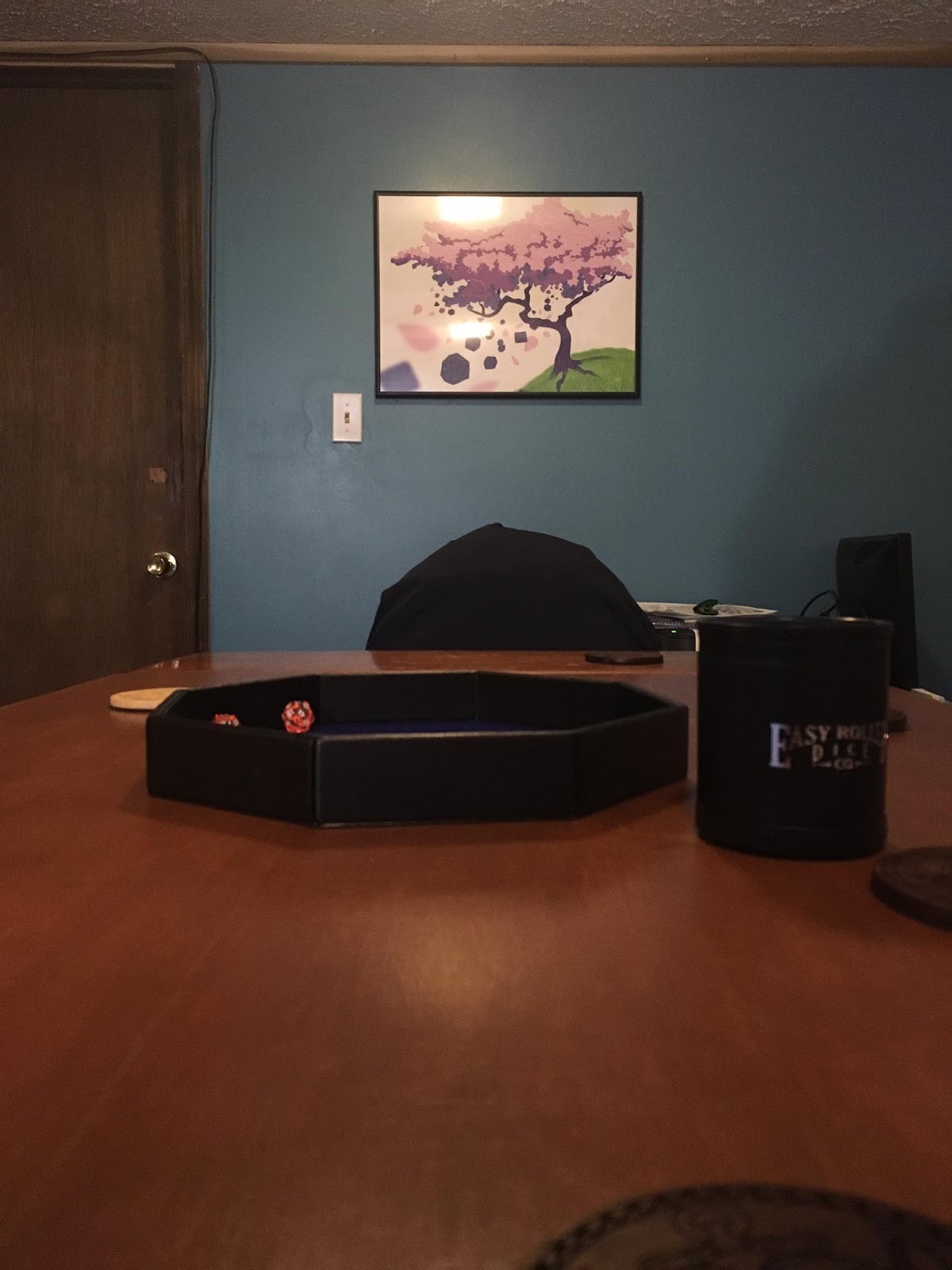
Over the past 3 years, board gaming and tabletop role playing has grown from being a hobby to being a way of life. With two regular RPG groups for both me and my wife and random board game nights, it was becoming such a hassle to find a place in my house to play games. If the dining table in my kitchen wasn't covered in stuff, my kitchen in shambles from dinner, or the card table and chairs not left out from the last time, it was a hassle to put together. On top of that, the environment didn't feel conducive to playing. The kitchen or office/living room would feel cramped.

It got even worse when you needed to add the card table in the kitchen!
So I set out on a mission. I was going to craft my perfect game room using what I had and or could get relatively cheaply. But to create a game room you need to start with the hardest part, the room. With all the rooms on my 1st and 2nd floor being either an office or bedroom, I turned my sights to my basement. Luckily, my wife and I had done some cleaning down there semi-recently. A group of friends had wanted to start podcasting and a room in my basement was turned into a studio. But the basement wouldn't have been my first choice of rooms with it's CMU blocks, band-aid colored paint, low ceilings, and dark light fixtures.

Would you want to play games down here?
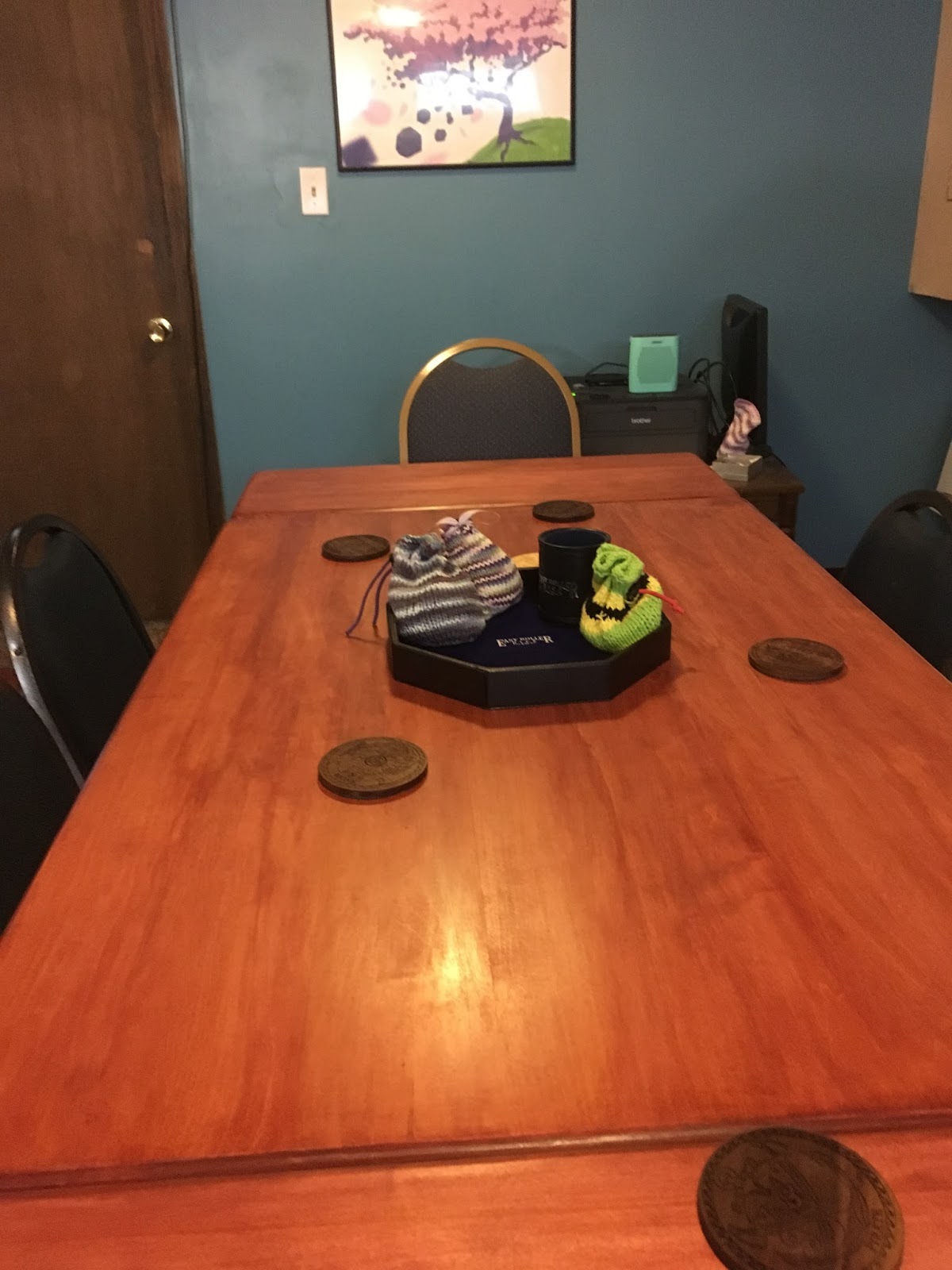
The table is, in my opinion, the most important part of any game room/setting. It will make or break your comfort and experience of playing. At first, I played around with the idea of turning the unused pool table into an imitation Geek Chic table (RIP). I was going to pull the metal feet of the pool table to lower it to a more acceptable/comfortable height and clean/refurbish the felt. But the more I played around with it, the more I decided that it wasn't what I wanted. While the lips of the those fancy gaming tables look nice and keep all your bits from flying off, I don't feel they are that comfortable for the 3 hour gaming session. I wanted a regular wooded dining table, but I didn't want to spend the money on such. But then there was a ray of hope. I was lucky to learn that with my parents moving, they had our old dining room table that they wanted to get rid of, and I swooped on it. Even though it was VERY beat up, it would be perfect for gaming. The table had two ends that would slide into the table when not being used. It could expand to give everyone space during an RPG or big game, and could collapse to play those smaller board games. The table itself was in rough shape though. A decade and a half of abuse in a 3 children house with animals, friends, and parties had not done it well. I attempted to refinish the table surface when I finally got it home, but my lack of wood working knowledge showed. I attempted to sand it down by hand with too fine of a sand paper, then applied a deck stain to it. Needless to say, the results were not great. The table looked splotchy and felt rubbery. But what ever. I needed a table to open the game room, and this would have to do.

Not great.

But it would have to do.
So then the game room officially opened, even though work was still to be done. The larger space and table really did the trick. It felt less cramped and there was space on the table for drinks. I spent time tracking down some affordable banquet style padded stacking chairs that really help make sitting in one place for 3 hours more doable. The game room was working.


Dice & Drinks

Perfect chairs for long time gaming.
Over the next few months I continued to work on fitting out the room. I happened to win some beautiful RPG themed wooden drink coasters at AcadeCon 2017. I decked out the walls with some nerdy and dorky artwork. For my 26th birthday I commissioned a piece of art from a friend to fit my game room. Other than being a little cold in the winter, it felt nice to be down there. But one thing kept nagging me. One thing that kept this game room from feeling perfect.

AcadeCoasters provided by https://www.rpgcoasters.com/
Custom art by Bex (https://www.girlilly.com/)

Lookin' good!
That damn table. Oh how it annoyed me. Like a scratch on your new car. Most people might not notice it, but you see it every damn time you step in or out of it. So in June of this year (2017) I decided tackle this table, correctly. I spent a good month before hand reading articles and talking to people about wood workings, learning as much as I could before I started. It seems simple. Sand, sand again, stain, sand, finish, sand, finish, sand. I borrowed an orbital sander from my grandfather, picked out some General Finishes stain and finish (Antique Cherry and a satin polyurethane), and went to town. A week later of shirtless sanding and staining, a mistake or two, and a lot of patience, I was the happiest man in the world. The table it ultra smooth with an amazing color. Your skin no longer stuck to it like the old rubbery stain that was on it before. Dice bounce of it with an incredibly satisfying knock. It is a dream.

Some of the pits from bubble from the deck stain.

Goodbye deck stain!

Oh, hello there Antique Cherry.

Oh, you so shine!

Results!
  While there is still more to be done to make it the ultimate game room, it is still pretty damn great at the moment. I would like to replace the door to the studio with a more modern looking white one (the current one has a hole in it on the studio side) and hide the entry to the nearby laundry room a bit better. A mini-fridge to keep companions drinks out of my kitchen fridge would be a luxury item and a cleaned up work bench would probably help as well. I would also like to stain the gas meter box that you can see in the first few pictures to something a little nicer. But until then, it's pretty damn great.

Relax! It's game night!

June 27, 2017

Split The Party Podcast

A couple of months ago, some of my Saturday night RPG group decided to start recording our post game discussions. These round table talks at a rectangular table have been spit out to the Internet as the Split The Party Podcast, which is currently available online and on iTunes. If you're interested in any gaming and general geekery podcasts, give us a listen and be disappointed. We're still working out how to do technical things properly, but we seem to have no shortage of content.

The podcast has been a fun creative exercise that spun off from the Splitscreen Show, a video game podcast done by some high school and college friends. After converting a room in my basement into a unprofessional recording studio, and the equipment from the Splitscreen Show being left down there, it was easy enough to just start recording our Saturday night post game discussions. Both podcasts have been fun to edit (or learn to edit from) and have become a stable creativity sink for me.

I think that's really all I have time to write about, so look for me on the other site: http://splitthepartypod.com/

February 9, 2016

Hit Point's Honesty

Most role playing games have some portion of them which is dedicated to combats and fights. Because of this, most systems also have some way to track your characters well being during the course of the encounter. The most common way to do this is through a stat called hit points, or hp for short. As the battle wears on and your characters lose hp, they are inching closer to being eliminated from the fight. But what exactly does hp stand for during these battles? Surely every lost hit point isn't blood drawn, or is it? In this article I am going to look a few examples of hit points (or similar mechanisms) in different RPG systems.

So let's start off with the big kahuna. In Dungeons and Dragons, nearly everything has a listed value of hp. A first level character may have around 12 hit points depending on class. As they gain levels, their hp increases, all the way into the hundreds. So, what do the hit points in D&D stand for? Well first we have to look at a few things. A character loses hp when they are hit with damage from an attack. Characters also gain hp when they level up. So, is hp loss is the result of physical wounds, does this mean that a level 5 character can be stabbed in the gut more times than a level 1 character? Logically, this doesn't make much sense. A football player will be taken out just as quickly with a stab to the gut as myself. HP in D&D is an abstract way to track a characters weariness. Damage represents close calls, near misses, and general fatigue that must be endured. That is, until you hit half of your HP. In D&D 4th Edition, characters gained a status called bloodied once they dropped below half of their max hp. This represented a physical hit on a character.

The One Ring RPG takes the idea of hit points and becoming bloodied and turns it into the concepts of endurance and becoming wounded. Characters lose endurance during a fight, and a physical hit is never landed until the character becomes wounded via the TOR equivalent of a critical hit. Being wounded in TOR is much more explicit and difficult to heal compared to endurance. Fate has a similar mechanic, tracking stress and consequences. Fate's consequences mechanic also has the benefit of being useful for social encounters, representing mental knocks and setbacks rather than physical ones.

FFG's Star Wars systems "fixes" this abstract hit point problem by having a stat called wounds. Wounds represent actual physical hits of blaster bolts and lightsabers on a character. This stat can be increased, but not in the same fashion or scale that D&D does. These wounds also lead to critical injuries, which maim and cripple characters. Strain is consumed and drained from characters for more mental and endurance consequences.

So if you're running a game and you want a better understanding of how to narrate combats, take a look at what the hit points in your system represents.

January 6, 2016

The Game Part of RPG

I've had the pleasure to experience over a dozen role playing game systems over the past three years. Most of these RPGs I have played, while some I've only read the rules on and I've started to notice a trend in the hobby, which a lot of people are already familiar with. This is the swinging pendulum of crunch. New games on the market trend with the swing of this pendulum. On one side of the pendulum we have rules heavy games and systems, and on the other we have extremely rules light. At the moment, I feel like we're on the up swing to the extremely rules light end of the pendulum, and this can be evident in what is hitting the table more and more these days.

Some of these rules light games I've read through include games like Questlandia and Fiasco. Both of these games focus so much on the role playing aspect of RPGs, that I sometimes wonder why they even bother coming with a book. Just through reading these rule books it got me thinking, I believe the game part of RPG is very important.

RPGs take aspects from two different mediums and slams them together into these books which we gather around for fun. Role playing on its own can be compared to acting or improv, which people take on characters and tell stories. Games are everywhere, they're essentially a contest with a distinct set of rules. Combining these two mediums into one we end up with essentially story telling with a set of rules, and I believe that having a good set of rules for a game is important. When it comes to rules light games, it sometimes feels like the rules were just thrown in there to make it a "game". Games like Fiasco and Questlandia feel like they have just as much depth in rules as Rory's Story Cubes.

The rules in an RPG serve two major purposes. They provide a framework that is (hopefully) balanced and equal for all players. They also provide an element of uncertainty. Any board game typically comes with a solid set of rules to use and it can come natural to role players to build a story out of actions that are taken during the game. These rules make the story interesting and unpredictable, throwing in complications that characters need to deal with in order to proceed. This may come natural to the theater and literary majors out there, but for everyone else, we need a little help. Part of this uncertainty has to be balanced though. Unbalanced rules lead to a narrative funnel, where all of the cool actions happen to a single player and everyone else feeling useless. Dice are a great randomizer and also very good for balancing if used properly, which is why we see so many games with dice.

While the weight of the rules and mechanisms for a game don't necessarily matter, the way that the rules integrate with the theme do. This is why it is easier for us to tack on a story to a board game than to tack rules on to an improv session. The rules need to facilitate the story, keeping the players immersed and engaged. Typically this is done via a good/bad traits mechanic. There are things your character is better and worse at than other people at the table (skills, aspects, traits, etc.). It's very simple, and is usually implemented unconsciously in normal story telling.

Without a good set of rules for an RPG it can feel like you're just sitting around a table making up a story. While I'm not calling this a bad thing (I like Rory's Story Cubes very much), I wouldn't call it a game either.  Questlandia and Fiasco offer very few rules and focus mainly on the story telling. I like to view these games as an assisted story telling exercise. Ultimately, when I play an RPG I really want solid mechanisms behind it.

December 28, 2015

PC Death in a Role Playing Game

Some GMs call it taboo. Other GMs revel in it. Most players despise it. The death of a player character is often a weird subject in most role playing games, to the point that some don't even acknowledge it. When telling a story that involves living thing, there are often times when that thing may die. What makes a role playing game different than cooperative story telling is uncertainty.  If you are telling the story together (like in straight improv), you and your partners want the outcome of some sort of conflict to be the most meaningful possible to construct a certain story. But in an RPG, there is often a mechanic which will semi-randomly decide the resolution of a conflict. Death in a straight storytelling setting is usually agreed upon during the story's construction. In an RPG, death could happen narratively like this, but more often than not, will happen via the roll of a die. This has led to much discussion over the consequences of killing off a PC. In this article, I will discuss a PC's death via game mechanisms from the eyes of a GM who views it as bad, a GM who views it as good, and the view as a player.


Lately, I've been hearing from multiple podcasts or people that I listen too that player character death via a die roll should never happen. If they're losing a fight, the characters don't perish, yet there is some narrative thing that happens that keeps them from dying. This can be used to keep the game pretty much on track. Introducing new characters into the game isn't easy, and getting them invested in the story is even harder. Most of these GMs will insist that a PC character should never be killed by goblin grunt #4 or Stormtrooper FN-2187, but rather if they are to be killed nonnarratively that the foe has a name. You rarely see in cinema or read in literature about the protagonist killed by a random extra. The PCs are exceptions, heroes, and generally awesome.

During my last D&D 5e game I just ran, I told my player's before we even started that I was not going to stop random monster x from killing them this campaign. My goal was to try and make this system as gritty as possible. In the first few weeks of the campaign, I had killed two of the PCs. When death is on the table for every instance, the game takes on a new dimension. The players now must be much more cautious, not just busting into any room they want and killing everything in it. They lose the sense of security they have when the GM takes death off the table for most encounters. They can make rash decisions with little fear of PC death most of the time. Keeping death on the table reigns this in. They want to avoid more combats now, and ones that are inevitable, they want to have the advantage. The down side to this is what I will call the 10 foot pole problem. The players are now overly cautious, tapping every flagstone and door with a 10 foot pole to check for traps or monsters before continuing. This will slow the game down tremendously. Luckily for myself, this didn't seem to happen during my D&D 5e campaign.

Those views are from the perspective of the GM, which is widely different than what a player sees. A player who's PC has been killed now has real world consequences. They now can not take part in the rest of tonight's game (easily) and now must invest more time into creating another character. Depending on the game system, this could be only a few minutes or a few hours. Nobody wants to sit at the table next to their friend as they play the game and you have to sit there digging through a book, especially if it's a new system. Now, occasionally PC death can be OK for a player. If the scene makes it incredibly cool, a player may make the choice to have a PC die. But it must be incredibly cool. As a player, real life time is usually more valuable than in game themes or story arcs. If a player has to make a choice between sacrificing themselves for an NPC, more often than not they won't do it. The story would be much better with the PC saving the princess in exchange for their life, but the player doesn't want to have to spend the next few hours building a character.

So that's my thoughts on PC death in an RPG. I switch up my GMing style depending on the system I'm running and the themes I want to play with. Currently, I am running a 13th Age game on the rare PC death spectrum. I believe that most systems should be run in this spectrum, because it makes it a hell of a lot easier for me to GM and keeps the game flowing pretty quickly. If my players start making rash and dumb decisions, I will find another way to punish them, which PC death may be delivered for a particularly brash offense.

December 17, 2015

D&D 5e Encounter Building and Campaign Thoughts

While I sit here avoid Twitter and Facebook, I decided to keep myself entertained by composing closing thoughts to my initial thoughts on the encounter building rules for Dungeons and Dragons, 5th Editions. After DMing a campaign that lasted from late June to mid November, running a game nearly once a week, I thing I gathered enough experience building encounters by the book. At the end of this post, I will also briefly discuss my thoughts on running a homebrew game in D&D 5e. But first with the encounter building rules.

In short, they're garbage. Complete trash that has killed off 7 characters over the course of the adventure. It feels like the CR system is flawed, either not fully considering an enemy's special ability or resistance. Half way through the adventure, after the party was decimated by a couple of lava slugs (reskinned fire snakes), I decided to just through out the encounter building rules and just eyeball it. This wasn't as difficult as it may have been for others, since I have become used to running systems that don't even include encounter building rules. Reflecting upon this, I should have reestablished the death ground rules. Originally, death was never off the table because I was stress testing the encounter building rules, but after not using them anymore, I should have reevaluated this clause.


It was too much work to build these fair fight encounters using the rules, and I don't think that you should invest too much time into creating D&D combats by the numbers. A good rule that I ended up using was to build fights with creatures that could be eliminated in 2-3 hits (or more if less creatures). I think the game thrives on many little, one sided fights during a day rather then a few fair fights, though this also depends on the characters in your party. If you have short rest dependent characters, I think that these favor fewer fights, since they always seem to have some amount of power ready to go. In the more weaker fights, the long rest characters don't have as big of hurdles to climb if they've already used up their big powers. So basically, ditch the encounter building rules and find out what works for your party.


Now, my general thoughts on running a nonpublished campaign in the new D&D 5e system. A quick summary of the campaign would be a fetch quest to find a special rock in the desert. There are a few things that stood out as issues, and in the end very little that I can find as enticing. So I'll start with the good first, go onto my issues, and then things that fell flat at the table. The game does a very good job at making "mundane" magically items extremely useful and powerful. A simple +1 sword or resistant cape goes a long way without giving the characters too much crazy power. A +1 "magical" weapon will beat many of the resistance types that a ton of the monsters seem to have (resistance to slashing, piercing and bludgeoning from non-magical weapons).  While I do enjoy the backgrounds and etc. for the characters, player's with poor backgrounds ended up getting hosed.

One of the problems I have with D&D 5e is that the monsters seem very boring. Only a few monsters had entertaining mechanics tied to them, while most had a form of multi attack if they needed to be more powerful. Abilities like Pack Tactics were good, but go boring after a while. The best designed monster was probably the Zombie, who felt like an undead force with it's Undead Fortitude ability.

Another issue is that there seemed to be a definite power balance issue. Classes like the ranger and sorcerer seemed out matched by the rogue, fighter and cleric. And because each character's powers function differently on short and long rests, it became difficult to build encounters to the appropriate difficulty for the number they did.

Some of the players had issues with the backgrounds and etc. mechanic. Either forgetting that they had them or trying to stretch to fill odd ones. The worst were players who created their own backgrounds etc. and then found it very difficult to gain advantage from them.

Some of the players seemed to hate the trinkets. Nearly anytime they found some source of treasure, I would have them roll on the trinket table for fun. I figured they would like getting little random items that they could think of using in future predicaments. But it was mostly seen as useless junk, and extremely disliked.

So would I run another 5e game again? Yes, but it would have to be for a certain tone and setting. I think for a gritty fantasy game, I would run this IF the story I wanted to tell couldn't be done in the One Ring. I think everything that I like about D&D 5e comes from its gritty difficulty and feeling, which I can get most of from the One Ring. For more high fantasy, I will stick with 13th Age.

Sorry that this article was so choppy. If I would have written right after finishing the campaign it would have better flow and more links (or any).